Redesigning how 220+ people work
What started as "cut our CRM costs" became a redesign of roles, workflows, and how an entire team relates to its customers.
What changed: The project evolved mid-flight when the buyer app launch changed the entire business model, and we had to redesign for a job role that didn't exist yet.
Impact: 40% reduction in operational costs · 220+ team members migrated · The business marked first year of profitability
Timeline: 3 phases: Foundation (1.5w) · Relationship continuity (2w) · Field & proactive engagement (2.5w)
My role: Solo product designer
Team: 1 Designer · 1 Product engineer · 2 dev

-40%
Operational costs
+9%
First-call resolution
220+
Team members migrated


Story,
A support agent gets a call, A buyer asks a simple question: "Why is my repayment overdue?"
To answer it, the agent opens the CRM, a repayment dashboard, an internal admin dashboard, a spreadsheet of conditions, and WhatsApp chat.
Five tabs. By the time the agent finds the answer, the buyer is already frustrated.
The issue wasn't her capability. It was system design.
The project was initiated by business to replace expensive third-party CRM tools and reduce operation costs.
Shadowing revealed two different worlds
We spent days with the teams, at desks during call rushes, and on the road during field visits.

Office; Agents on calls, switching between 6+ browser tabs, spreadsheets, WhatsApp Web

Field visits, agents at buyer shops, finding different infos, calling the office for data they couldn't access on the move

In customer's office, helping customers to
onboard, teaching them how to use tools,
discussing term, issues and offers
"I open 5 tabs to answer one question. By the time I find the info, the customer is already frustrated."
Senior support agent, 3+ years
There's no one I can call and say, you know my business, help me with this, Different person every call.
Customer, Bangalore
Insights
Teams were managing tickets, not customers
The existing setup is optimised for task closure: resolve the ticket, close the issue, and move the queue forward. But the business needed relationship continuity, understanding buyer history, spotting financial risk, building trust over time, and growing fund utilisation.
The tools were designed for support operations. The business had evolved beyond support operations
Continuity gap
A buyer's story was split across agents and tools. History existed. Continuity didn't.
Dead-end support
The support function could drive retention and revenue, but operations limited it to reactive ticket closure.
Cognitive overload by design
Re-entering data across tools. Slow escalations.
The tools created extra work.
No ownership
Multiple agents touched a single buyer across channels. Everyone owned the ticket. Nobody owned the relationship.

Problem
area
These seemed like separate issues, but they were actually a single systemic failure. No one saw the full picture of the customer relationship, and the tools actively prevented them from doing.
As the business scaled, the cost wasn't just in software subscriptions; it was in slow resolutions, missed context, and eroding customer trust
Phase 1: Foundation
Migration without disruption. Build
the critical flows. Create structure
from chaos.
Phase 2: Continuity
One RM, one buyer, full history. The business model changed, and so did the tool.
Phase 3: Guidance
From a system of record to a
system of proactive action. Field visits,
meetings, risk signals.
Phase 1 : Migration without disruption
220+ people using existing tools daily. If disrupting their workflow, we'd lose trust before the project could prove itself.
Build only what matters most. We mapped which 40% of flows handled 80% of daily volume and built only those. Everything else was deliberately parked.
Unified customer profile
One screen for contacts, financial history, event and status timeline. The design decision was sequence: what does an agent need to see first when a call comes in, and what do they need to reach within two clicks


What broke in testing,
We designed for 30–40 tickets per agent. Agents had 200+. The date-ordered ticket list we built was useless at that scale,
they missed urgency, follow-ups, and escalations.

During shadowing, I watched agents constantly switch between a notes tab, a file tab, and an organisation tab,
I vibecoded a timeline that merged every interaction type into one feed. It eliminated the switching and became one of the time-saving features.
Phase 1: Designed in 8 days. Parallel development. 2-week pilot before full rollout. Positive adoption from week one.
Then the business model changed.
The buyer app launched. Self-service replaced phone calls.
-72% of support calls disappeared
Support and sales merged into one new role: Relationship Manager. One person would own 50-70 buyers end-to-end; calls, visits, financial guidance, and escalations. This role didn't exist when we started. The tool wasn't designed for it.
The team no longer needed ticket context. They needed customer context.
Phase 2 : One manager, multiple tickets
One person managing 50–70 buyers. They needed to understand a buyer's full situation within seconds of getting call and opening their profile. and Manage sub-tasks linked to specific tickets without losing the thread. Spot financial risk signals without digging through reports.
The old tool showed individual tickets. The new role needed a relationship view, every interaction, every financial signal, across time.
Cross-ticket timeline
Complete history across all tickets,
not just the current issue.
Linked sub-tasks.
Complex issues broken down without losing parent context.
Behaviour visibility
Credit utilisation, repayment discipline, risk signals
Escalation paths
Built into the view so nothing fell through.


Cross-ticket timelines, behaviour visibility, linked sub-tasks, clear escalation paths
Result: less switching, more context, and higher first-call resolution.


Multi ticket management

Escalation visibility

Multi disposition

Escalation summary
Phase 2.2 : Structured Issue Reporting
Buyers raised issues through support calls and messy WhatsApp messages. Agents spent multiple rounds of clarifying before they could act.
+ Buyers had no visibility into the status of a raised ticket; no updates, no closure.
Direction 01: Ticket timeline view
Direction 02: Chat-style interface

Pros
▶ Transparent progress
▶ Sets clear expectation
Cons
▶ Feels robotic and detached
▶ Unfamiliar UI pattern
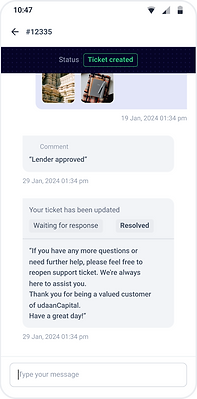
Pros
▶ Intuitive: Matches how people naturally
use messaging apps
limited availability of agents to respond instantly.
Cons
▶ Users expect immediate
▶ Delays feel more annoying in a chat
window
We chose a structured form approach with guided questions that helped buyers describe their issue clearly, with file-attachment support. Users got simplicity. RMs got clean inputs to act without back-and-forth.


Guided form, category selection, structured input, file attachment


OUTCOMES
40%
Cost of operation reduced by
Dependency on external CRM subscriptions was removed, and existing servers were reutilised.
9%
First-call resolution rate increased by
Percentage of queries solved in the first call without callbacks = stronger trust + stronger back and forth
18%
Percentage of ticket created through in-app flow
Users start adapt to new flow

Phase 2.2 : Proactive Field Operations
Support management had stabilised. The next frontier: preventing problems instead of chasing them.
RMs now need to proactively visit buyers offline, in the field. Before this, meetings, notes, and follow-ups happened outside the system entirely. We introduced workflows for scheduling, buyer performance snapshots, location check-ins, visit notes, follow-up reminders, and early risk signals.
Desktop planning, mobile execution
An RM plans the visit at their desk with full buyer context visible. They execute it from a phone, marking arrival, reviewing performance, logging notes, and scheduling the next visit, often in a parking lot between meetings.
Scheduling a meeting (Desktop)


Mobile first for field meetings
Performance awareness, reschedule and mark location
"RMs became more than just responders. They became advisors. They walked into meetings informed. They followed up and they started preventing escalations instead of reacting to them."
OUTCOMES & IMPACT
13%
Limit utilisation
increased by
Business growth
23%
Number of ticket created by user decreased by
Proactive solutions
20%
Overdue repayment reduced by
Follow-up on repayment and safety
220+
Team members migrated
WHEN I LOOK BACK
-
Early phase: I optimised interfaces. Made things cleaner, faster, more usable. Applied design thinking.
-
Middle phase: I connected information. Made context travel with people. Systems thinking.
-
Final phase: I shaped team behaviour and business outcomes. Strategic design.
MY LEARNINGS
Zoom out from screens to systems, and understand users and their environment. Understand behavioural change
WHAT I'D DO DIFFERENTLY:
Build a feedback loop and flag issues into the tool itself
Thank you